

How to Inspect Footwear
Whether you are developing a new footwear line, inspecting production samples, buying sneakers, or simply trying to understand what separates a good shoe from a bad one, learning how to evaluate footwear quality is an essential skill.
The Footwear Quality and Inspection Guide emphasizes that a professional inspection should look beyond appearance. Materials, construction, assembly technique, workmanship, and even the inside of the shoe all contribute to overall quality.
For readers who want to go deeper, Shoemakers Academy also offers the Footwear Inspection and Quality Control online course. The course is designed for footwear designers, developers, brand builders, product managers, sourcing professionals, and anyone responsible for footwear quality.
Learn more about the Footwear Inspection and Quality Control Course →
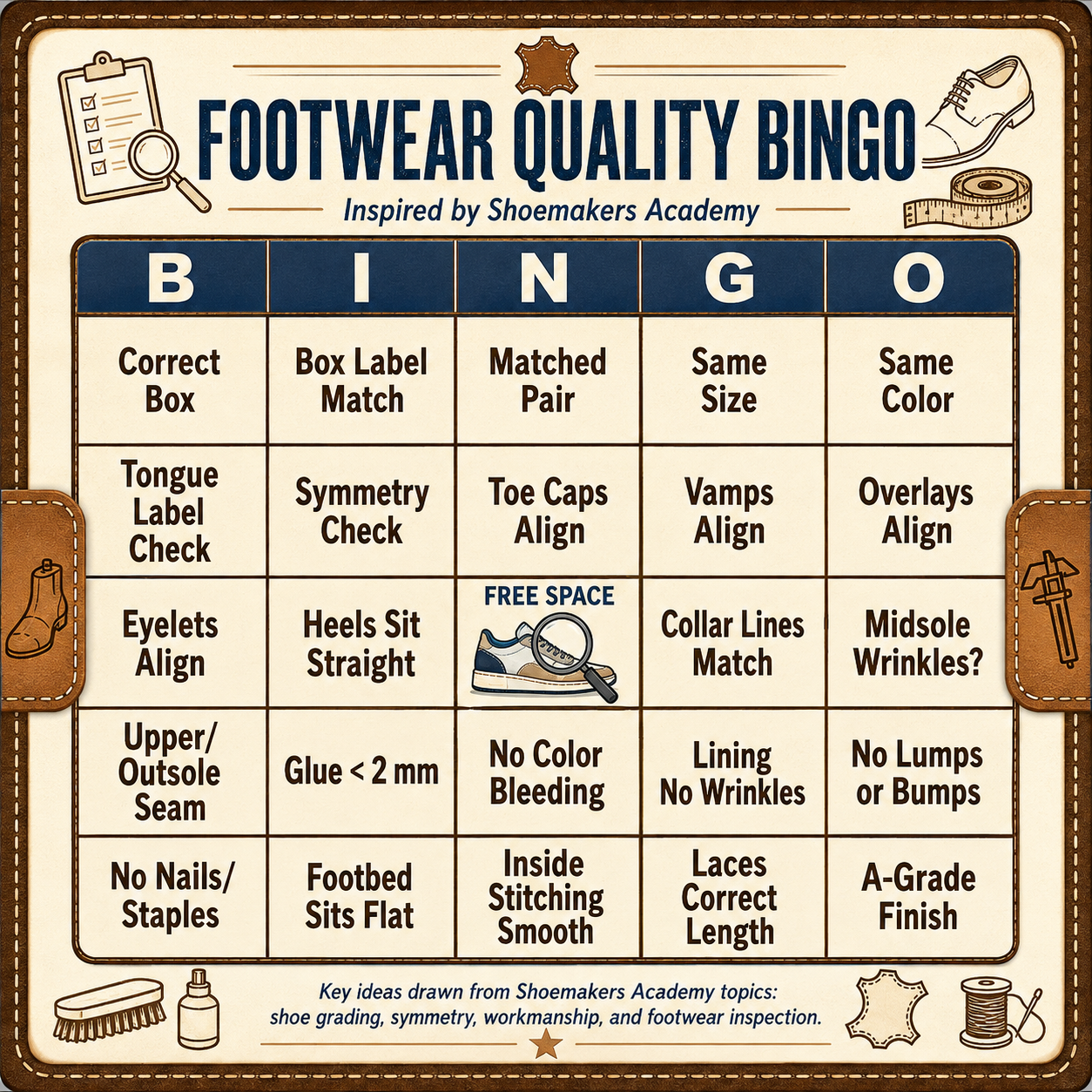
To make footwear inspections easier—and a little more fun—we have also created our new Footwear Quality Bingo Card, based on many of the practical inspection points covered in our quality control training.
Start With the Basics: Is It the Right Pair?
Before studying stitching or materials, start with the packaging and basic product information.
Check that the shoes are in the correct box, that the box is clean and appropriately sized, and that the box label matches the shoe’s color, model, and size. Confirm that you have a proper left and right shoe and that both shoes are the same size and color. The tongue labels should also match the product information.
Several of these checks appear directly on our Footwear Quality Bingo Card, including Correct Box, Box Label Match, Matched Pair, Same Size, Same Color, and Tongue Label Check.
Symmetry Is a Major Sign of Quality
One of the most useful footwear inspection techniques is comparing the two shoes directly.
Place the shoes bottom-to-bottom to confirm that they are the same length. Then roll the uppers together side-by-side and compare the position of the toe caps, vamps, overlays, eye stays, and eyelets.
Check the heels as well. The shoes should sit straight on their outsoles, and the back height and collar lines should match.
Symmetry is an important signal of a high-quality shoe.
That is why symmetry plays such a big role on our bingo card. When your team starts calling out Toe Caps Align, Eyelets Align, Heels Sit Straight, and Collar Lines Match, they are practicing real professional footwear inspection skills.
Look Closely at Materials and Workmanship
Next, inspect the materials and stitching. Compare colors, textures, emboss patterns, and material direction between the left and right shoes.
Look for loose or broken stitches, rough cutting, melted thread ends, pressing marks, dirty logos, wrinkles, poor trimming, or seams that expose stitching.
The outsole and midsole areas deserve special attention too. Look for midsole wrinkles, poorly fitted sole components, color bleeding, excess glue, and crooked or separating outsole parts.
A useful industry quality checkpoint is over-gluing. Glue should not extend more than approximately 2mm above the outsole edge.
Naturally, Glue < 2mm earns its own square on our Footwear Quality Bingo Card.
Do Not Forget the Inside of the Shoe
A shoe can look perfect on the outside and still have serious quality problems inside.
Check that the lining is clean and wrinkle-free, the footbed sits straight and flat, and the collar does not contain uncomfortable lumps, bumps, or glue spots.
Run your hand inside the shoe and inspect the tongue, vamp, toe area, and footbed edges for rough stitching, wrinkles, hard spots, or other defects that could cause discomfort.
This is where bingo squares such as Footbed Sits Flat, No Lumps or Bumps, Lining No Wrinkles, and Inside Stitching Smooth become useful inspection reminders.
Learn Professional Footwear Quality Control
The Shoemakers Academy Footwear Inspection and Quality Control Course takes these inspection skills further with professional training focused on footwear quality, shoe grading, factory inspections, quality systems, testing, and common manufacturing defects.
The course includes 11 lessons covering professional footwear inspection and quality control techniques for designers, developers, sourcing teams, brand builders, and footwear professionals.
Explore the Footwear Inspection and Quality Control Course →

Turn Quality Control Into a Team Skill
The goal of an inspection is not simply to find defects. A professional footwear inspector must also determine whether a problem is an isolated mistake or evidence of a systematic manufacturing problem.
If the same defect appears repeatedly, there may be a problem with a particular factory operation, worker, material, machine, or quality-control procedure.
Use our new Footwear Quality Bingo Card during sample reviews, factory inspections, team training, classroom sessions, or quality-control workshops. It turns technical footwear inspection checkpoints into an easy and memorable learning activity.
Once you learn what to look for, you really may never look at a pair of shoes the same way again.
Start Learning Footwear Quality Control at Shoemakers Academy →