

Shoe Pattern Grading : How to make sizes
How to Grade Shoe Patterns

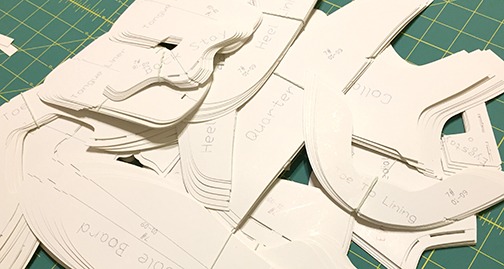
In the footwear manufacturing process, the sample size shoe pattern is always confirmed first. Afterward, the pattern master will make the pattern pieces for all the remaining shoe sizes. This process of adjusting the pattern for each shoe size is called shoe pattern grading. A complete, graded, production pattern for a typical sports shoe will require over 200 individual shoe pattern parts. Each pattern part will require its own cutting die.
Shoe Pattern Grading
Shoe pattern grading is done according to the last sizes. While each shoe last will have its own specific contours and unique outline shape, the size grading increments are standardized. For men’s shoes, the length of the last changes 4mm per USA half size and 4mm per European size (full sizes only). The US standard size 9 last is 276mm long, and the size 9.5 is 280mm long.
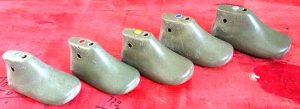 The shoe lasts’ other critical dimensions also change per size, but at different rates. For example, the ball girth is graded at 3mm per size, and the ball width (measured across the bottom of the last) measures 66% of the total ball girth. For men’s size 9, the ball girth is 234mm and the ball width is 156mm. Also, while the shoe length increases 4mm per half size, the collar height and back height increase only 1mm per size.
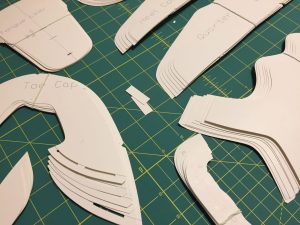 The shape of each shoe component will change per size depending on its location. The tongue length will increase quickly according to the last length, while the width grades slowly according to the girth.
The heel mustache’s width will increase more than its height as the sizes get bigger. The back counter parts also increase quickly in width according to the last length while the height grade is small.
Which shoe parts don’t grade?
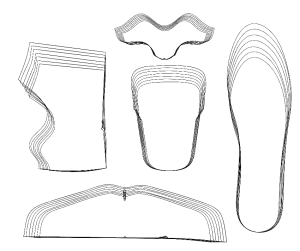 Not all the features of a shoe pattern are graded. For example, the pattern overlaps and lasting margins are not graded.
Pattern grading in a modern shoe factory is done by a computer. The middle size, or sample pattern, is digitized by the pattern assistant. Next, the computer takes over grading the pattern according to the last dimensions already stored in the program. In the old days, a pantograph machine was used to trace the pattern. The geometry required for the arms to adjust according to the length and width of the pattern parts was done by hand.
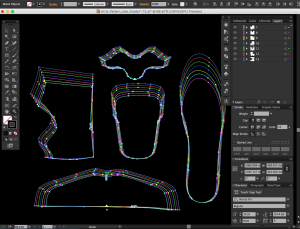 Once the pattern is graded, the pattern master will check it by hand. The pattern master then instructs the sample room to make the trial patterns. The trial patterns are checked for visual proportions and outsole fitting. Once the patterns are approved, the cutting dies will be made.